Architectural Evolution: From Prototype to Production
To balance rapid user testing with long-term scalability, the development of Campass is split into two strategic phases. This page outlines the architecture for both our initial client-side prototype and our upcoming full-stack production environment.
Phase 1: Client-side Prototype (React/Vite)
Status: Completed & Deployed | Visit Prototype Site →
The prototype architecture was engineered for zero-latency exploration. By leveraging GitHub Pages for static hosting and the Browser's LocalStorage for state, we eliminated backend overhead to focus entirely on validating the core "Treasure Hunt" UX and 3D rendering performance.
1.1 The Prototype Blueprint
This diagram visualizes the decoupled, client-centric structure of our initial build. Hover over the hotspots to explore how we managed state without a database.
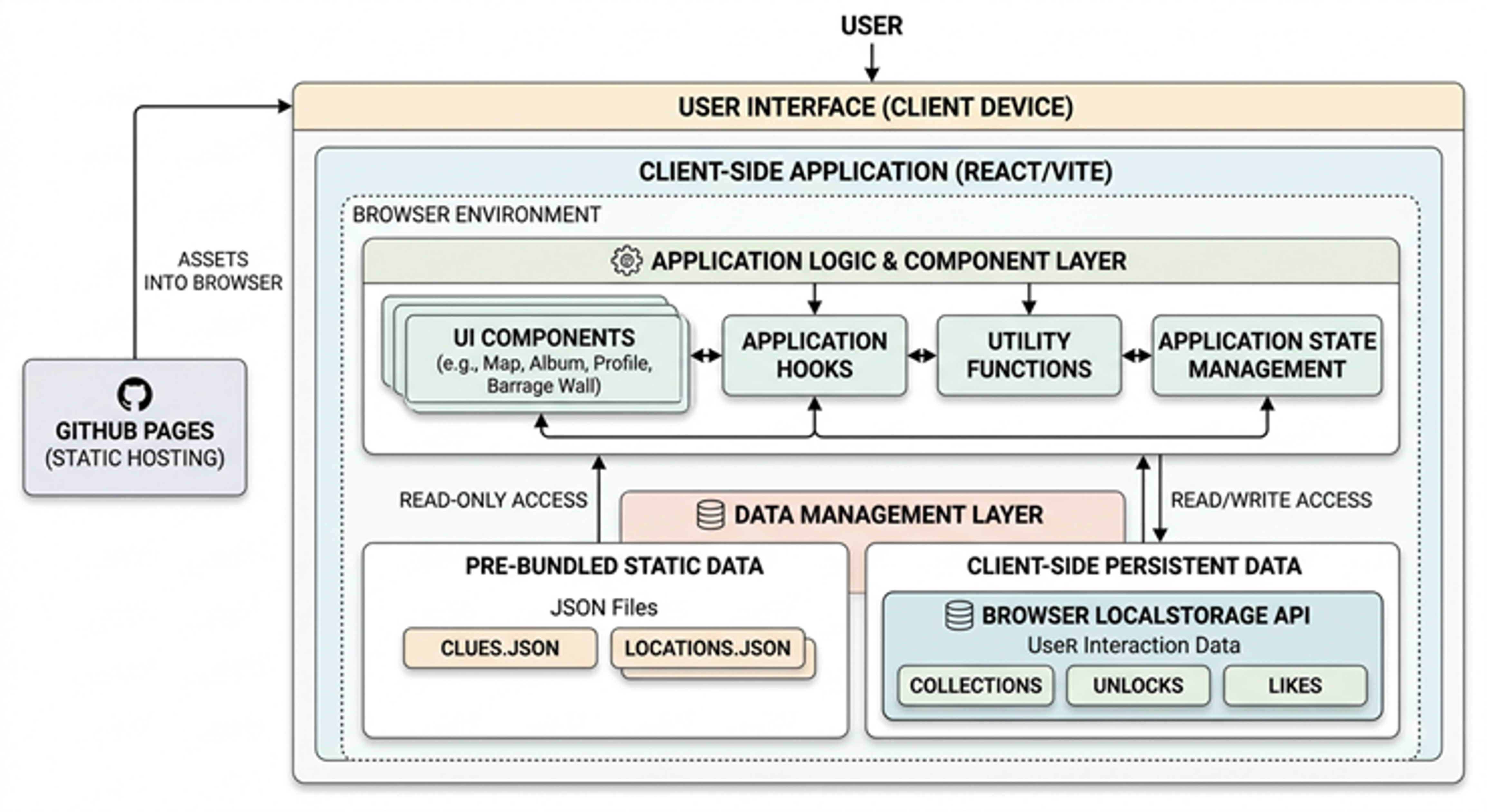
Hover over the pulsing hotspots on the architecture diagram to reveal technical details.
1.2 Engineering Pillars
The prototype relies on three key technical pillars to achieve an "app-like" experience within a static environment:
Stateless to Stateful
How: Through LocalStorage to store Collections (captured birds) and Unlocks (visited landmarks).
Benefit: Ensures user progress persists across reloads without waiting for database queries, enabling "instant feedback".
Data Management Layer
How: Uses static JSON files (CLUES.JSON) to preload landmark information.
Benefit: Drastically reduces Largest Contentful Paint (LCP) with all queries acting as memory-level O(1) operations.
Modular Hook Architecture
How: Core logic is fully encapsulated within custom React Hooks.
Benefit: When migrating to a Next.js full-stack setup, UI code remains intact; only the data-fetching hooks need to change.
Phase 2: Fullstack Production (Next.js)
Status: Frontend Refactored / Backend in Progress | Visit Beta Preview →
We have successfully refactored the entire frontend into the Next.js App Router architecture. This transition marks our shift from a local-only prototype to a robust, cloud-connected platform. While the frontend is live, we are currently developing the server-side modules to support global persistence and real-time social features.
2.1 The Roadmap to Production
The following table outlines our transition from a stateless prototype to a fully integrated full-stack system.
Static Prototype
Next.js Fullstack
| Feature | Phase 1: Prototype (Static) | Phase 2: Next.js (Fullstack) |
|---|---|---|
| Hosting | GitHub Pages (Static) | Vercel (App Router) |
| Data Storage | LocalStorage (Browser) | PostgreSQL / Vercel KV |
| Asset Management | Pre-bundled Static Files | Vercel Blob (Dynamic CDN) |
| Social / Persistence | Local Memory Only | Real-time WebSockets / Supabase |
2.2 Ready for Scalability
By utilizing Modular Application Hooks in the prototype phase, our codebase is already decoupled. Migrating from localStorage methods to a Prisma + PostgreSQL backend is a streamlined process, requiring minimal changes to our UI components while unlocking multi-device synchronization and global leaderboards.